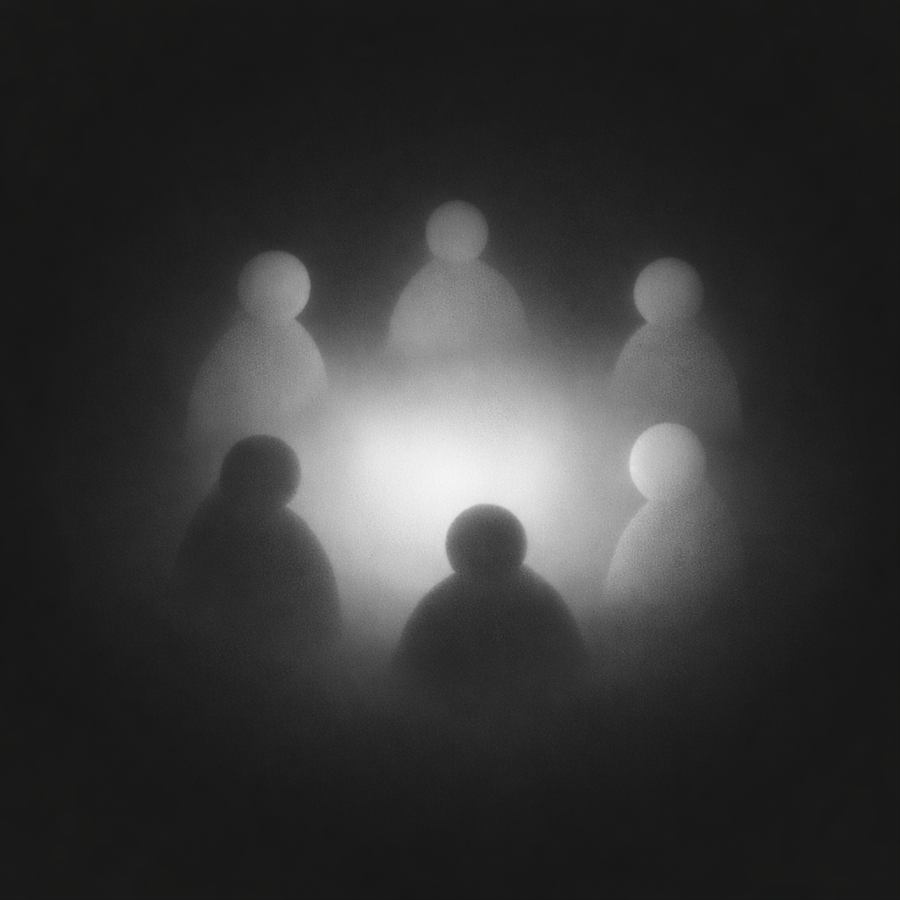
I Am Because We Are
No one has ever become fully human alone. Every tradition that has asked what it means to live well, across centuries, across continents, across languages, has arrived at the same conclusion: we are made in relationship. Identity is not something we carry inside and then share with others. It emerges between us. It is forged in the moment someone truly sees us, and we see them back.
The Southern African philosophy of Ubuntu expresses this with radical simplicity: a person is a person through other people. Aristotle, twenty-three centuries ago, reached the same place from a different direction. He argued that the good life — what he called eudaimonia — is impossible in isolation. It is grown through bonds of virtue, through friendships that demand something of us. Emmanuel Levinas went further still: the very beginning of ethics is not a principle or a rule, but a face. The face of the other person, looking at you, calling you to responsibility before you have chosen anything.
These are not borrowed ideas. They are confirmations. What I hold to be true — that we exist in connection, that isolation diminishes us, that belonging is not a luxury but a condition of being human — is older than any technology, any platform, any market. I build as though it were still true. Because it is.
Presence, Not Performance
Attention is the rarest and purest form of love. To give it fully — to another person, to a single moment, to the silence before a conversation begins — is the most radical act available to us.
Simone Weil called attention the natural prayer of the soul. Not because it is religious, but because it is the one act that requires the whole self — undivided, unoptimised, unperforming. And it is precisely this act that modern platforms have learned to harvest. Every notification, every algorithmic nudge, every engagement metric is an extraction of the one thing that should be sacred: the ability to be fully present.
Presence cannot be automated, scaled, or faked. But it can be stolen — and it is, every day, by systems designed to capture attention and convert it into their metrics. Every minute held by a screen is a minute not spent with the people in front of you.
The measure I carry into every product decision is simple: if someone closes the app and returns to their life a little more present, that is the design working. I do not optimise for presence captured. I optimise for presence returned.
Being, Not Having
Somewhere along the way, we were taught to collect. Followers, likes, connections, metrics — as though accumulating them meant something. As though a network of a thousand acquaintances could substitute for one person who knows your name and means it.
Erich Fromm spent a lifetime diagnosing this confusion. He described two fundamental modes of existence: the having mode, in which a person defines themselves by what they possess, control, and consume — and the being mode, in which a person is alive through experience, presence, and genuine relationship. Modern digital life has overwhelmingly chosen having. We count followers like currency. We measure worth in reach. We confuse visibility with significance.
The shift I insist on is not new. It is a return. A network is a structure you have. A community is something you are part of — something that changes you, and that you change. The difference is not technical. It is moral. And every time we design for accumulation instead of participation, we push people deeper into the wrong mode of living.
Trust, Not Transaction
Martin Buber described two ways a person can relate to the world. In the I-Thou relation, you meet another person as a whole being — present, unpredictable, irreducible. In the I-It relation, you treat them as an object to be used, categorised, and discarded. Both are part of life. But a civilisation that has forgotten I-Thou — that relates to everything and everyone as an It — has lost something it cannot replace.
The platforms we use today have industrialised I-It at a scale Buber could not have imagined. Every interaction is a transaction. Every person is a profile. Every relationship is mediated by a rating, a score, a conversion metric. The question is never "who is this person?" but "what is this person worth to me right now?"
Trust is the opposite of this. Trust is not a five-star rating — it is contextual, earned, specific. You trust someone as a driver differently from how you trust them as a borrower. You trust them because someone you already trust vouched for them, and that vouch carries weight because it carries risk. This is how trust has always worked among humans. The goal is not to invent a new system. It is to restore the one that was there before platforms replaced it with metrics.
Community, Not Network
A network is a structure. It connects nodes. It optimises for reach, efficiency, and throughput. It does not ask whether the nodes care about each other. It does not require commitment. It does not grieve when a node disappears, because it was never aware of it as anything more than a point in the system.
A community is a commitment. It is a group of people who have agreed — explicitly or through their actions — to show up for each other. It is smaller than a network. It is harder. It is worth more.
Epicurus, whom history has misremembered as a hedonist, stated plainly what most people feel but cannot articulate: the greatest of all goods is friendship. Not the casual kind — the kind that costs something, that asks something of you, that changes you. The kind where showing up is the point, not the means to something else.
Communities govern themselves. One person, one vote. Money buys convenience on the platform — but it cannot buy influence. The people who shape a community are the people who show up for it.
Assembly, Not Swarm
Hannah Arendt drew a distinction that becomes more urgent every year. She separated action — the genuine, unpredictable, deeply human capacity to begin something new — from behaviour — the conditioned, predictable, managed response of a person reduced to a pattern.
Every platform that exists today is optimised for behaviour. Scrolling is behaviour. Reacting is behaviour. Sharing without reading is behaviour. The algorithmic feed does not want you to act — it wants you to behave, because behaviour is predictable and predictability is profitable.
An assembly is where action happens. It is a gathering of persons who face each other, who carry responsibility for each other, and who leave changed by what took place. A swarm moves together but shares nothing real — it is noise with momentum, a crowd without interiority. Every viral moment is a swarm. Every algorithmic pile-on is a swarm. Every platform that counts engagement as a measure of community is building swarms and calling them gatherings.
The alternative is a notice board where things happen and people decide whether to show up. Deliberation spaces where decisions are made together. Technology that supports the conditions for action, then steps aside.
Convivial Infrastructure
In 1973, Ivan Illich published Tools for Conviviality and gave language to something most people already felt: there is a threshold every technology crosses — the moment it stops serving human flourishing and begins extracting from it. A convivial tool is one whose purpose is chosen by the person using it, that can be used freely without requiring certification or permission, and whose use by one person does not diminish its availability to another.
The telephone, in Illich's time, was a convivial tool. Anyone could dial anyone. The purpose — business, love, argument — belonged to the caller. The tool enabled and then was silent. What we have today are tools that listen after the call ends. Tools that decide who you should call next. Tools that sell the content of the conversation to someone you never met.
Convivial infrastructure means: the technology is controlled by the people it serves, not the people who run it. The platform exists to facilitate connection — it does not curate, rank, or monetise that connection. It does not decide what matters to you. It does not retain your attention beyond the moment you chose to give it. This is not a design trend. It is an ethical position.
And it applies wherever you build — regardless of the industry, regardless of the product. The question of how much of this you can bring to what you're working on is always open. Even a partial answer changes what you build.
The Fullest Life
Viktor Frankl survived the concentration camps and emerged with a single conviction: meaning is not something you find by looking for it. It is something that finds you — as a side effect of dedicating yourself to something beyond your own comfort. "The more one forgets himself, by giving himself to a cause to serve or another person to love, the more human he is."
Aristotle arrived at the same place through reason rather than suffering. Eudaimonia — the flourishing life — is not a mood. It is not happiness in the modern sense. It is what a life looks like when it is lived in accordance with virtue, in relationship with others, in service of something larger than the self. It cannot be purchased. It cannot be optimised. It is the quiet consequence of living well with others, over time.
This is where the bridge leads. The platform is not built so that people can connect — connection is not the destination. It is built so that connection becomes the ground on which a fuller life grows. The carpool conversation that becomes a friendship. The lent tool that becomes the beginning of trust. The community that builds something together because they decided to, and nobody told them to.
The fullest life has never been the one lived for oneself alone.
Every idea on this page is ancient. Not one of them is new.
Convivium Resurgentia
The rising of presence